

뉴스
GenixCure shifts from AAV vector to platform, targeting CNS and rare diseases with next-generation AAVs
2026-02-03
[Interview] Moon Hongsung, Founder of GenixCure
[by Kang, In Hyo] GenixCure is a Korean biotechnology venture focused on the development of a next-generation adeno-associated virus (AAV) vector platform. Leveraging its proprietary AAV technology, the company seeks to overcome the limitations of existing gene therapies, particularly in applications targeting the central nervous system (CNS) and rare diseases.
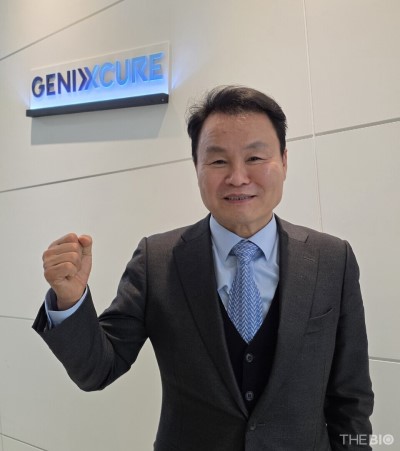
In a recent interview with , Moon Hongsung, founder and CEO of GenixCure, stated, "In the near term, our priority is to secure globally competitive capabilities in AAV vector technologies targeting the CNS and the blood-brain barrier (BBB), while continuously generating outcomes through co-development initiatives and technology transfer."
"Over the mid- to long-term horizon, we aim to construct a diversified pipeline that can be expanded across multiple indications based on our platform technology, thereby evolving into a 'next-generation gene therapy company' capable of delivering practical and clinically meaningful treatment options to patients," Moon further commented.
In an interview conducted on January 27 at the company's headquarters in Suwon, Gyeonggi Province, Moon outlined GenixCure’s management strategy, core business initiatives, and plans for an initial public offering (IPO), including fundraising objectives for the year.
◇Transitioning from a single gene therapy asset to an AAV platform company
Founded in April 2019, GenixCure initially concentrated on the development of gene therapy-based treatments for Alzheimer's disease. However, the high level of scientific complexity of this approach resulted in heightened development risks as well as a significant financial burden.
"As a more fundamental way to strengthen our competitiveness, we shifted our focus to the development of an 'AAV vector platform.' And through our independently developed 'CARE (Computationally Assisted Rational Engineering)' system, we successfully secured next-generation AAV vectors," Moon explained.
"GenixCure is currently positioning this next-generation AAV vector platform as a central pillar of its future growth strategy and is strengthening its global competitiveness through innovative vector development that leverages artificial intelligence (AI) technologies, alongside collaborations with Korean and international partners," he added.
AAV vectors employ relatively safe viral vehicles to enable the precise delivery of therapeutic genes to specific target tissues and cells. This technology platform has already been clinically validates and is being applied in commercialized gene therapies for rare diseases, including spinal muscular atrophy (SMA).
GenixCure is concentrating its R&D activities on the development of next-generation AAV vectors through its proprietary machine learning (M/L)-based AAV engineering platform, InsightMiner. In contrast to conventional methodologies that depend on iterative experimental screening, InsightMiner applies AI trained on large-scale human biological data to predict capsid amino acid sequences with high relevance to human cells and strong clinical translatability. Moon explained that this approach enables the rational design of AAV vectors with greater precision and improved safety profiles, allowing for more accurate tissue- and cell-specific gene delivery.
"We are advancing the development of an AI-driven, tissue-specific AAV vector platform as a central pillar of our corporate strategy. We possess end-to-end execution capabilities to systematically translate our technological advances into preclinical and non-clinical validation data and to extend them toward commercialization through collaboration and investment," Moon remarked.
◇Next-generation AAV vector achieves 450-fold greater CNS targeting than wild-type AAV9, demonstrating both technological and commercial viability
Developed through InsightMiner, GenixCure's proprietary machine learning-based AAV engineering platform, XOB-031_v2 (development code GenC2) demonstrated approximately 450-fold enhancement in CNS targeting efficiency compared with wild-type AAV9. In addition, validation studies conducted in a non-human primate model confirmed superior infectivity and gene delivery efficiency relative to wild-type AAV. Moon emphasized that these results represent a meaningful advancement in both delivery efficiency and safety, two longstanding challenges in the treatment of CNS disorders.
"Building on these technological advances, we conducted joint research in 2025 with DongKoo Bio&Pharma using the XOB-031_v2 (GenC2) vector, while simultaneously divesting a portion of the vector's equity, resulting in a transaction valued at around KRW 1 billion (approximately USD 684 thousand)," Moon explained. "This outcome clearly demonstrates both the 'technological competitiveness' and the 'commercial value' of our next-generation AAV vector platform and lays a crucial foundation for expanding future co-development initiatives and technology transfer discussions with global pharmaceutical companies."
"Beginning in February 2024, we will continue to submit patent applications for 'cell-specific' AAV vectors, and we are steadily reinforcing an exclusive intellectual property (IP) portfolio for our entire next-generation AAV platform, including XOB-031_v2 (GenC2)," Moon further stated.
At present, GenixCure's CNS-targeting AAV vectors, including XOB-031_v2 (GenC2), are being positioned as strategic assets for both domestic and international co-development and technology transfer opportunities. Moon further noted that discussions are also underway regarding the potential expansion of this platform across a broader range of therapeutic indications.
"We regard the AAV vector platform not merely as a delivery technology but as a technology-transfer-oriented asset capable of continuously creating optimized pipelines tailored to individual diseases. In line with this strategy, we are gradually building a pipeline with clear clinical and commercial value, focusing on 'rare neurological disorders,'" he said.
◇Expanding AAV pipeline for rare neurological disorders, extending from Lafora disease to ALS and SMA
A prime example of GenixCure's rare neurological disease pipeline, as highlighted by Moon, is 'GXC-301 (development code),' a gene therapy candidate targeting Lafora disease, a rare pediatric neurological disorder for which no curative treatment is currently available. GXC-301 has been granted both 'Orphan Drug Designation (ODD)' and 'Rare Pediatric Disease Designation (RPDD)' from the U.S. Food and Drug Administration (FDA).
"I believe this milestone will significantly enhance both the clinical profile and commercial visibility of our pipeline during co-development and technology transfer discussions with global pharmaceutical companies. Our company is also advancing the development of 'GenC2M,' an AAV variant engineered to selectively target motor neurons in the spinal cord, with therapeutic applications aimed at amyotrophic lateral sclerosis (ALS, also known as Lou Gehrig's disease) and SMA," Moon remarked.
"GenC2M has been designed to maximize transduction efficiency in motor neurons, and we are evaluating it as a strategic asset with platform-level potential for technology transfer in the area of 'rare neuromuscular diseases,'" Moon added.
Moreover, GenixCure is conducting non-human primate-based screening studies aimed at identifying AAV vectors suitable for ophthalmic indications, including macular degeneration, as well as AAV variants targeting muscle-related diseases. Moon explained that this approach is intended to proactively secure vectors with high clinical translatability and to systematically build a portfolio that can be licensed to global pharmaceutical companies on an indication-specific basis.
"In parallel, we are developing next-generation therapeutic technologies based on ribonucleic acid (RNA) editing through collaborative research with the Korea Advanced Institute of Science and Technology (KAIST). By integrating AAV vector technology with RNA editing, we aim to develop novel treatments for rare neurological disorders, including SMA. Over the mid- to long-term, we are also positioning this platform as an independent pipeline for potential technology transfer or co-development," he further said.
◇Last year marked the ‘first year of the platform era,’ integrating technology, business, and reliability to build the next-generation AAV foundation
Moon evaluated the previous year as a pivotal period in which GenixCure ‘fully established’ the technological and commercial foundations of its next-generation AAV vector platform. From an R&D perspective, the company significantly strengthened its core IP portfolio by registering and filing patents covering pharmaceutical compositions for the treatment of Lafora disease and Lou Gehrig's disease, as well as submitting a patent application for a CNS-targeting AAV vector. Additionally, GenixCure published the results of a joint study with Samsung Medical Center analyzing AAV delivery efficiency in an international scientific journal, thereby providing the scientific validation of its AAV vector platform technology.
"We have established a next-generation AAV library with BBB penetration and CNS cell targeting capabilities and have completed administration studies in non-human primates. Among these candidates, our lead asset, the 'CNS-targeting AAV capsid (GenC2),' has generated meaningful biodistribution data in a primate model, providing a solid foundation for subsequent discussions on co-development and commercialization," Moon explained.
In 2025, GenixCure entered into a joint R&D and rights transfer agreement with DongKoo Bio&Pharma for its next-generation AAV vector technology, underscoring the platform’s potential for commercialization. Moon emphasized that this milestone demonstrates that GenixCure's AAV vector technology has proven its business value beyond the research stage.
Furthermore, the company secured funding to support its R&D efforts last year after being selected for three government-backed R&D programs totaling approximately KRW 1.1 billion, including the Startup Leap Package, the SME Technology Innovation Development Project, and the Advanced Medical Product Non-clinical Validation Support Project. In addition, Moon noted that the year marked a period in which GenixCure not only strengthened its technological prowess but also its managerial stability and external credibility, as reflected in the receipt of multiple government and biotechnology-related awards, as well as certifications recognizing its family-friendly policies and commitment to work-life balance.
"Through a series of government-funded projects, joint research initiatives, commercialization outcomes achieved in partnership with the private sector, as well as the receipt of various awards and certifications, we have secured not only our technological capabilities but also our capacity for business execution and our credibility with external stakeholders," he commented.
◇Series B funding gains momentum, accelerating commercialization of the AAV platform
GenixCure has designated 2026 as the year to ‘clearly demonstrate’ the commercial viability of its AAV vector technology. To this end, the company plans to secure AAV vectors exhibiting high BBB permeability and strong CNS cell specificity in primate models, while progressively constructing an AAV library with the capacity to expand into indications such as SMA and ophthalmic disorders.
"In collaboration with the research team at KAIST, we will accelerate the development of next-generation therapeutic modalities that integrate AAV-based RNA editing and control technologies. Using our proprietary AAV vectors, we plan to conduct animal studies targeting Lafora disease and Lou Gehrig's disease, with the aim of enhancing the quality of our preclinical data," Moon stated.
Recently, a growing number of Korean pharmaceutical and biotechnology companies have begun adopting vectors developed by GenixCure for gene therapy development. Notably, a major domestic pharmaceutical company, referred to as company C, and a gene therapy specialist, referred to as company N, have entered into material transfer agreements (MTAs) with GenixCure and are currently conducting evaluations on vector performance. In parallel, the company is also pursuing collaboration for co-development research with a KOSDAQ-listed company E, as well as with gene therapy developer G.
"Both Korean and international pharmaceutical companies and biotechnology firms have shown considerable interest in GenixCure's 'high-efficiency AAV platform.' One data point from primate studies of our AAV vectors, scheduled for the first half of 2026, is secured; we intend to accelerate discussions toward full-scale technical collaboration and partnerships. We also plan to broaden MTAs and co-development negotiations with domestic AAV gene therapy developers, with a strong focus on converting our platform technology into concrete business results," Moon highlighted.
GenixCure is currently in the process of raising a Series B financing round totaling KRW 8 to 10 billion (approximately USD 6.8 million). Last year, the company secured KRW 2 billion in investment from Dongkoo Bio&Pharma CO., Ltd. and etc. Also the company is currently reviewing an additional KRW 1 billion investment from a government-affiliated financial institution, with the aim of completing the transaction in the first half of this year. GenixCure previously raised approximately KRW 12 billion in Series A funding in 2021, underscoring investor confidence in its technological prowess and growth potential.
"In the second half of the year, we plan to secure an additional KRW 5 billion in funding from new institutional investors as well as existing Series A investors, aligned with the acquisition of preclinical data. Through this, we will further substantiate the potential of our platform to 'advance our platform technology' and advance the 'commercial viability of our key pipelines,'" Moon said.
In H2 2025, GenixCure signed an underwriting agreement appointing Korea Investment & Securities as the lead manager and Hanwha Investment & Securities as a co-manager, thereby initiating full-scale preparations for an IPO. The company is currently undertaking a parallel restructuring of its internal management system while strengthening its mid- to long-term business structure and is advancing a phased IPO roadmap with the goal of achieving a public listing in early 2028.